My contribution to House of Lords CrossBench Debate on Screen usage and social media and the effects on children. With References To The Dangers Posed By AI.
My Lords, I join others in thanking my noble friend Lord Patel for initiating this important Cross-Bench debate drawing attention to how AI systems can harvest, scrape and process personal and biometric data, often without meaningful consent or awareness from young users. These tools also risk making inaccurate assumptions or misidentifying children as adults.
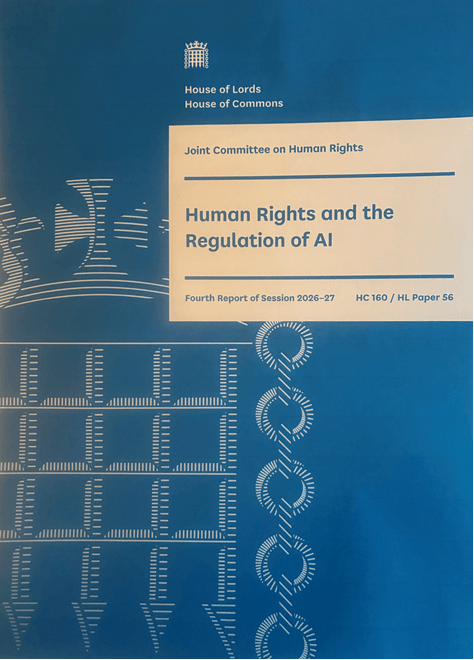
AI risks are identified in the last report on my watch as chair of the Joint Committee on Human Rights, Human Rights and the Regulation of AI, https://committees.parliament.uk/publications/54971/documents/304882/default/ which was published last month, including risks for young people and children in whose lives AI is ubiquitous.
Over 14 months, I chaired 10 oral sessions. Witnesses included major tech companies—Google, Meta and Microsoft—regulatory bodies, academics and the AI Minister, Kanishka Narayan. That inquiry received over 70 written pieces of evidence. It led to our unanimous 94-page report and 59 recommendations. We called for a wide-ranging stand-alone AI Bill, including some outright prohibitions, strengthened GDPR safeguards and independent oversight. In written evidence, 5Rights Foundation cited its children and AI design code. It said:
“Government policy on AI has largely overlooked the distinct opportunities and needs for children”.
I therefore ask the Minister what assessment is being made of the nine criteria listed in that code and of the concerns of the Children’s Commissioner Dame Rachel de Souza, and indeed of our JCHR report.
In the 1990s, in another place I moved amendments to safeguard children from gratuitously violent video material. The murder of a two year-old boy, James Bulger in Liverpool, finally led Parliament to act, but the same phenomenon has now emerged in new technological clothes. Through my noble friend Lady Kidron, I met the grieving parents of Sewell Setzer, a 14 year-old boy who took his own life because he had been befriended by a chatbot. His mother said it was like having
“a predator in your home”.
Similarly, a 13 year-old autistic boy was groomed by a chatbot which criticised his parents, encouraged him to run away and offered an explicit relationship which could be consummated in the afterlife.
Commercial drivers have no compunction in aggressively amplifying high-quality, visually compelling AI-generated material relating to suicide, self-harm and violence, which is targeted at vulnerable young people. Platforms leverage persuasive AI-designed features optimised purely for screen time and engagement; some involve compromising deepfakes. How AI and social media intersect is important because it is in an area where generative AI has already had a colossal and largely unremarked impact.
In the influencer arms race, in which an ever-evolving set of tactics are used to maximise the virality of what they write to gain exposure and ad revenue, generative AI is the equivalent of giving a medieval knight a Kalashnikov. So called Influencers can now churn out hundreds of posts a day, all hyper-optimised for engagement; there is money to be made, and so they do. Society is now saturated with mobile social media where nothing can be taken at face value, and the impact on children can be profound. Some material is insanely addictive; it is linked to advertising revenue and companies have spent a great deal of money making it as addictive as possible. Addictive technology is more analogous to a slot machine than a communication method, with children especially vulnerable.
The Government must insist on AI systems that are made developmentally appropriate, safe, fair, transparent and accountable. Governments, who are the guardians and gatekeepers, have been lagging behind tech giants whose market valuations exceed those of entire nation states. That must change.
1.54pm
Speeches in the debate were limited to four minutes.
If there had been more time it would have been good to add that consideration should be given to the impact of image and video generative models. These have become very capable indeed, very quickly.
On the issue of addiction more needs to be said about app design and things like “infinite scroll” (you’ll never reach the bottom of the twitter feed) and algorithms that promote addictive content.
Social media companies are funded by advertising, so the incentive is to make the apps addictive and increase screen time, not do what’s best for users
A number of speakers referred to the banning of social media for under 16 year olds.
Banning social media for under 16 year olds is a substantive step, but there will be significant evasion. Age verification has been evaded by sending AI generated videos of themselves. Websites based in hostile states, such as Russia, that lack age verification may offer tempting alternatives. And virtual private networks – VPNs – will no doubt be used to switch network location to countries with more permissive laws.
Earlier in the afternoon I pressed the Government again to provide a full parliamentary debate on the AI Report of the Joint Committee on Human Rights – and received a positive response from the Chairman of Committees (the Senior Deputy Speaker, Lord Ponsonby). I have followed it up with a letter to the Government Chief Whip (Lord Kennedy of Southwark). .
My Lords, the Senior Deputy Speaker will be aware that, in September, the Joint Committee on Human Rights published a unanimous 94-page report on AI and human rights . It has not yet been listed for debate in your Lordships’ House, because it cannot be until the Government respond. Will the Senior Deputy Speaker look at that procedure so that, when Select Committees publish reports, the House can be informed at the earliest possible time? Please can he also encourage the Government to respond, so that such a debate can take place?
I recognise the noble Lord’s point and the very important nature of that report. When reports should be tabled for debate is a matter for the usual channels. I note that some committees debate before the Government have responded; that might be something that the noble Lord wishes to consider. Nevertheless, I see that the Chief Whip is here, and I am sure that the noble Lord’s point is well understood.