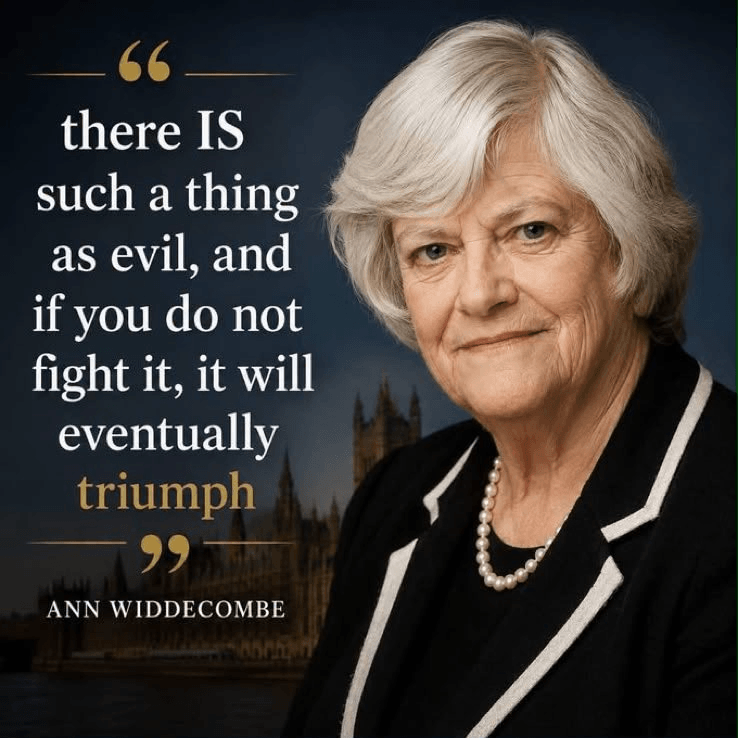

Fearless, honest and articulate, Ann Widdecombe was a warm and generous friend. A conviction politician whose principles were underpinned by her faith and patriotism, she was always true to her herself. Words by Lord Alton, Baroness Hoey and Baroness Browning. Click here:
https://www.politicshome.com/opinion/article/tribute-ann-widdecombe
Politics Home:
Ann Widdecombe was a fearless and faithful friend, writes Lord Alton
In 1979 we nearly became election opponents when she and Frank Field chased the Conservative and Labour nominations in the by-election at Liverpool Edge Hill.
Nine years later, now MP for Maidstone, Ann joined the Standing Committee on my Private Members’ Bill to reduce the 28 weeks upper time limit for abortion. At meetings all over the UK we spoke at public meetings explaining why, despite other political differences, we were united by our belief in the right to life.
Ann had been deeply shocked by the Carlisle baby case – a baby aborted at 21 weeks gestation – and she later asked the Commons, “how can one accept, when a child has been breathing without the aid of artificial equipment, has a pulse rate and has survived for three hours, that that was not a live birth? Under what circumstances do we call a person an unperson?”
She never hesitated to ask difficult questions.
She loathed eugenics, human cloning and experiments on human embryos and feared assisted suicide would endanger people with disabilities.
With CS Lewis she also believed that if you are cruel to other species, it wouldn’t be long before you are cruel to human beings too.
Her love of animals led her to accept the presidency of societies caring for donkeys and hedgehogs, and to her rescuing stray cats: Pugwash and Carruthers being two of the most notable.
One night, driving her to a meeting in the north of England, I was told to “stop the car”: She had seen a stranded hedgehog. It was rescued and taken to safety.
She passionately opposed fox hunting – unlike some of her local party who tabled a hostile motion at an AGM.
I secured a supportive statement for her from a retired general who wrote to her party members: “I fought the Mau Mau and she’s exactly the person I would have wanted standing alongside me.” She successfully saw off the motion.
As I got to know Ann, I rapidly realised that behind the sometimes-gruff exterior was a principled, extraordinarily articulate, intelligent woman – not easily deterred. Her formidable debating skills, developed as a student in the Oxford Union, were deployed to great effect for all her causes – political, social, and charitable.
She was also intensely kind – to family, friends, and strangers.
In her mother’s final years, Ann brought Rita to live with her in London – telling me that, just as her mother had cared for her when she came into the world, she would care for her beloved mother as she left this world for the next. She did just that.
After one combative session on a Home Office bill, she told me, ‘you are still my favourite bleeding-heart liberal’. I took it as a compliment
As a godmother to one of my children she unfailingly always asked after him, travelling miles to be with him for his baptism and first communion.
I saw that kindness in terrible tragedy too.
We shared Sir David Amess as a good friend.
Following David’s appalling murder, and totally in character, Ann remained close to Julia, David’s widow, showing practical and continuing care, celebrating David’s life when we attended the unveiling of his statue in Southend.
Ann’s convictions were underpinned by the twin pillars of her faith and patriotism, insisting that we must use our lives to the full: “We get one go this side of eternity, one go. Life is not a dress rehearsal.”
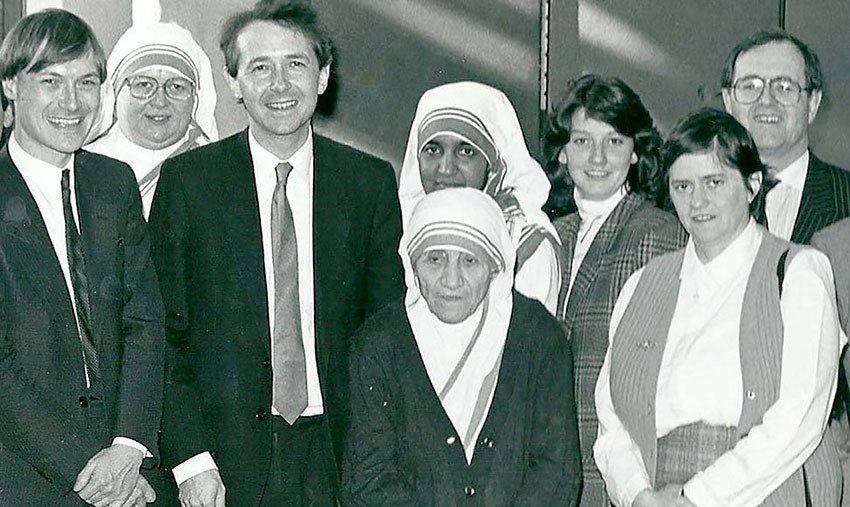
Her faith manifested itself in her causes, through support for charities for the persecuted, the vulnerable, the poor – through the work of Right to Life, the Leprosy Mission, the St Vincent de Paul Society. It expressed itself in her devotion to Mother Teresa – whom she met at Westminster – and whom she later defended against Christopher Hitchens and in a 2016 BBC Songs of Praise programme exploring the characteristics of a saint.
In 2013, in recognition of Ann’s work, Pope Benedict named her a Dame of the Order of St Gregory the Great.
Ann’s patriotism had its roots in her upbringing – partly in Singapore, where the father she adored had worked as a civil servant in the Ministry of Defence. In June, in our last conversation together – in Kennington over a favourite tandoori masala – we shared our concerns about the UK’s lack of preparedness as we face the “deadly quartet” of dictatorships threatening our freedoms.
Whether you agreed with Ann, or not, her forthright views were always trenchantly, intelligently, and honestly expressed and never with malice. In a toxic climate of inflammatory hate speech, that respect for difference must be the key to learning to live together.
Even when Ann and I were on opposite sides of political arguments, we agreed to disagree and never fell out. After one combative session on a Home Office bill, she told me, “you are still my favourite bleeding-heart liberal”. I took it as a compliment.
In 1993 to mark her decision to become a Catholic she chose the hymns at the weekly mass in the Westminster chapel of St Mary Undercroft.
The last of those hymns was Faith of Our Fathers. Its final verse has a particularly poignant resonance:
…we will love
Both friend and foe in all our strife,
And preach thee, too, as love knows how
By kindly words and virtuous life.
Faith of our fathers! holy faith!
We will be true to thee till death!”
Ann was always true to herself.
May she now rest in peace.
Lord Alton of Liverpool is a crossbench peer

Ann Widdecombe with Phyllis Bowman, and MPs Ken Hargreaves and Sir David Amess at a Right To Life Meeting

1999 Ann Widdecombe’s Roscoe Lecture – with David Alton and Professor Peter Toyne.


1993 Ann Widdecombe made a Ministerial Visit to Liverpool and David Alton arranged to take her to Mersey Tec to discuss work opportunities for young people