Morocco Summit on Freedom of Religion or Belief: July 20th 2026
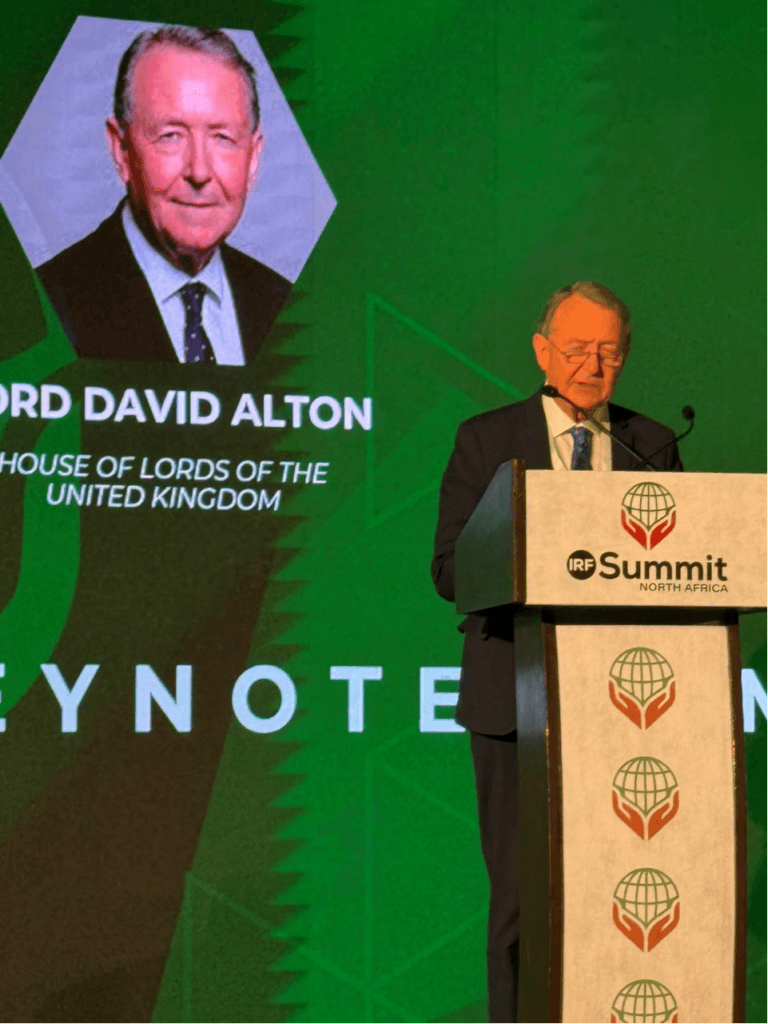
I want to pay tribute to Sam Brownback and Katrina Lantos Swett, the co-chairs of this important international Freedom Summit, and for bringing us to the beautifulRoyal Kingdom of Morocco. I was privileged to meet Katrina’s father, the great Tom Lantos – and today she stands in his shoes. I first met Sam when he was in the US Senate and later to visit him in his home State of Kansas while he was Governor. Together they have moved religious liberty from the periphery into a defining human rights question.
May I also pay tribute to Amina Bouayach, the wonderful chair of the Moroccan Human Rights Council. I hosted Amina when she visited the British Parliament and I greatly valued our discussions then and again yesterday.
The Alaouite Royal Family also deserve our enormous thanks for facilitating dialogue about the challenge of diverse peoples learning to live together in mutual respect.
Casablanca is celebrated in Humphrey Bogart’s 1943 Second World War movie described by General George Patton – who in 1942 led the US Seventh Army here in Operation Torch – as a “mixture of Hollywood and the Bible.” Not a bad combination!
Elsewhere in North Africa my father was a Desert Rat, a young British soldier in the Eighth Army at the famous battle of El Alemain.
In the 1980s as a young MP I travelled in the Maghreb to see the landmarks and terrain.
The last time I was in Morocco was in Marrakesh in 2023, to speak at the first Inter Parliamentary Union Summit to consider the burning issue of religious freedom.
Marrakesh was chosen for the IPU Conference because in 2016 it was where the seminal and important Marrakesh Declaration was signed.
More than 250 Muslim scholars, heads of state, and religious leaders affirmed the rights of religious minorities in predominantly Muslim-majority countries.
It calls for equal citizenship and religious freedom based on the seventh century historic Charter of Medina, to ensure equal treatment of all groups in shared, diverse societies.
The 2016 Declaration was crafted against the bloody backdrop of the 2015 brutality of Daesh genocide against Yazidis and Christians in Syria and Iraq, which I saw firsthand.
Tackling hate speech head on, it urges Muslim educational institutions to review curricula to remove teachings that incite aggression. It encourages political leaders to establish constitutional laws protecting religious freedom for all.
The Declaration contains an echo of Article 18 of the 1948 Universal Declaration of Human Rights – which insists that every man and woman has the right to believe, not to believe, or to change their belief.
The reality, though, for hundreds of millions of the three quarters of the world’s 8 billion people who are said to identify with a religious belief is rather different.
Widespread persecution often morphs into atrocity crimes and even genocide.
Ask the 360 million Christians who experienced ‘high levels of persecution and discrimination’ worldwide last year – with some 13 Christians killed every day. Ask the Uyghur and Rohingya Muslims, ask the Tibetan Buddhists, Jews, Baha’i, Falun Gong practitioners, Yazidis, Ahmadis, Hazara, Humanists, and many persecuted in societies where no respect is shown for the right to religious liberty or Article 18.
The world’s shameful collective failure to see religious persecution as the canary in the mine, a predictive warning of worse to come, is the reason for so much suffering. The denial of religious liberty is always a harbinger. Religious liberty is directly linked to national security issues and to economic stability and prosperity.
If Article 18 is the human right which is routinely ignored, it is also a litmus test of the health of a society.
Take North Korea where I have been on four occasions.
A UN Inquiry says it’s “a state without parallel” committing crimes against humanity.
Check out North Korea’s hatred of religion, the incarceration and execution of people of faith, and measure it against North Korea’s abject poverty.
Faith and freedom, prosperity and religious liberty, are two sides of one coin.
Destroy one and you destroy the other.
Those countries which deny religious freedom are serial human rights abusers – denying every other human right too.
Sam Brownback is right that Article 18 is “the human right of the soul.”
Nations that uphold religious freedom uphold other freedoms too. That is why it matters so much.
Policy makers need to get a grip of this and recognise that when you impose a Stalinist/Maoist reign of terror on religious believers and trample Article 18 and religious liberty there will be no truly human flourishing.
They also need to better understand the connection between the conflicts generated by war lords or Jihadist ideologues and the mass displacement of 120 million people worldwide – and the role which distorted religion can play in the conflicts which fuel displacement. We spend great political capital in the symptoms but far too little on the root causes.
When it comes to the religious dimension of conflicts and displacements in countries like Nigeria, Eritrea and Sudan, and right across sub–Saharan Africa there is too much religious illiteracy among policy makers.
There are nearly 4 million displaced people in Nigeria alone.
Ask those people , ask Leah Sharibu, a girl abducted at 14, raped, impregnated, forcibly converted and still in captivity if she believes she was seized because of climate change and conflict between herders and farmers, or whether the curtailment of religious freedom is the major animating driver of Boko Haram and ISIS West Africa.
Ask the 1.3 million Rohingya Muslims forced out of Burma and now displaced in sprawling camps in Bangladesh if they are merely victims of a military dictatorship.
I have seen for myself the smouldering remains of a village madrasa in Burma, torched by hostile militias acting in the name of their religion and I have stood in the ruins of a church and school in Sudan destroyed because it was the wrong religion.
I have been in Northern Iraq and met the survivors of the genocide; been to Tibet and Western China; met victims of appalling anti-Semitism; and in my work as chair of the Joint Committee on Human Rights of the British Parliament, I have met too many individuals whose lives have been irreparably changed by the failure to protect people of religious faith.
Meeting those who have been beaten, tortured, imprisoned, raped, or bereaved never leaves you unchanged.
You can’t put your hands into someone else’s wounds and remain unaffected.
In the early years of my political life I visited Ukraine I met Bishop Pavlo Vasylyk and Ivan Gel, a politician and dissident, who had spent 17 and 18 years in the Kremlin’s death camp at Perm. I met a young priest sent to Chernobyl, without any protective clothing, to clear radioactive waste for publicly celebrating the liturgies.
Knowing their stories; seeing for yourself; collecting evidence; not merely relying on press and second-hand reports; building alliances across political divides with likeminded people: that’s the only way to make Article 18 and religious liberty more than a political slogan.
We must be like the great British parliamentarian, William Wilbeforce, and his friends, in former times; we must be like the geese on the Roman citadel who woke up the citizens and political leaders to infamy and danger.
Let me briefly end with two further thoughts.
Next month my Parliamentary Committee will report on the challenge of Artificial Intelligence to Human Rights.
Artificial intelligence is already shaping how people access information, how communities communicate, how governments monitor public life, and how rights are protected or undermined.
AI has enormous potential to advance human rights — from documenting abuses and translating testimony to improving access to education and amplifying voices that are too often ignored.
Yet we have already seen how authoritarian states can use these same tools to monitor communities, restrict religious expression, censor dissent, spread disinformation, and identify or target those whose beliefs are viewed as a threat to state power. Think particularly of the CCP and China.
Political leadership on AI must mean more than innovation and investment. It must also mean ensuring that AI is rooted in human rights, accountability, religious literacy, and the protection of conscience.
No person should be reduced to productivity, usefulness, or data. Every human being has dignity, freedom, interior life, and conscience. That insight is central to any serious discussion of AI and FoRB. A future summit might consider how both AI and social media’s role can be used to stigmatise, inflame hatred, to sow division and how we can best meet that challenge.
My other though concerns displacement.
Along this North African coast I would like to see a generous Marshall-aid project to build new settlements – new Carthages – removing the need for people to make perilous and dangerous journeys. Modelled on Singapore – or on Hong Kong before its evisceration by the Chinese Communist Party – they could be safe places where Article 18 is the foundation principle. Harnessing clever Israeli desalination projects and far-sighted Moroccan energy projects would make them viable.
And to make them great and prosperous places to live they must be founded on the unalienable rights of life, liberty and the pursuit of happiness, all the hallmarks of free societies.
Notwithstanding the Boston tea party 250 years ago I am glad to tell my American friends that today these universal aspirations unite us.
We merely want for all what we want for ourselves – the freedom to believe.
Thank you for inviting me to speak to you at the opening of this important Summit.