Speech recalling the Bosnian Genocide and the fragile situation today in Bosnia-Herzegovina
My Lords, on this day last week, the noble Baroness, Lady Helic, spoke powerfully in the debate on genocide and atrocity crimes, pledging support for my Genocide Determination
Bill, which will be debated on 17 July. Today, as we recall the horrific depredations of the Bosnian genocide and the massacre at Srebrenica, she has eloquently taken us to the current and urgent situation in Bosnia-Herzegovina.
In the context of Putin’s seizure of sovereign territory and illegal attempts to change borders by force, this must surely constitute the most dangerous moment since Dayton. Given Russia’s interference in domestic affairs across so many countries, we need far greater NATO unity in our response and we need to hear more American voices joining ours in insisting that Bosnia’s borders must be guaranteed.
The Global Centre for the Responsibility to Protect spells out the risks, including weakness of state structures and institutions, civic space under threat, hate speech, incitement and targeting of specific groups. Republika Srpska has intensified its efforts to erode and undermine the authority of the formal state Government and state-level institutions, including enacting legislation openly challenging the jurisdiction of the constitutional court and other central bodies. Recent trends in nationalist rhetoric, leading to the normalisation of denial of the Srebrenica genocide and narratives exacerbating ethno-nationalist tensions, create a fertile ground for hate-based violence. What are we doing to help strengthen state-level institutions, including by capacity building and monitoring, to accelerate the expeditious prosecution of war crimes without further delays and to support efforts to counter hateful narratives and genocide denialism?
There are new challenges. The Global Centre points to how
“Digital technologies, particularly the rise of generative AI, have accelerated the spread of narratives that weaponise societal grievances, undermine trust in democratic institutions and erode electoral integrity”.
The Joint Committee on Human Rights, which I have the honour to chair, is currently looking at AI and human rights. It is alarming to see how AI could be used to contribute to atrocity crimes or exacerbate the risks thereof.
Can the Minister please tell us when the last joint analysis of conflict and stability was undertaken by the FCDO in Bosnia and how we have used its findings? Can he spell out the role of the FCDO atrocity prevention unit? Following the Bosnian genocide, the 1948 convention on the crime of genocide—given to us by Raphael Lemkin, who gave us the word “genocide”, meaning the cutting of the human family—with its duties to prevent, protect and punish, requires signatories, of which we are one, to look for predictive early warning signs and risk factors. Are we doing that?
We urgently need to agitate for a new high representative, expose the role of corrupt deals and lobbying, uphold sanctions and never forget the consequences when we last looked away. The world’s attention deficit and the temptation for international juggernauts to move on simply will not do.
—
Concealed Surveillance Equipment in Government Offices and Vehicles
Private Notice Question
3.52pm
Asked by
To ask His Majesty’s Government, further to the reported discoveries of concealed surveillance equipment in Government offices and vehicles, what assessment they have made of the implications of this for (1) national security, and (2) public policy.
The Minister of State, Home Office
In line with the practice of successive Administrations, this Government do not comment on the detail of internal security matters, but I can confirm that an electronic device was found in a communal area of the Ministry of Housing, Communities and Local Government during a routine security check. The device was not in or near ministerial offices, and it is currently being investigated by the appropriate agencies. The Government have also looked into the Daily Mail report and previous coverage and have not discovered any evidence of a tracking device being placed in Prime Ministers’ cars. This is based on inquiries made at the time, and more recently.
Sharethis specific contribution
I am grateful to the Minister for that reply.
That disclosure was made yesterday to a Select Committee in another place—that a Chinese cellular module was discovered in the then Prime Minister’s car—and on the previous day, there was a report of secret cameras being discovered in government offices. Surely that raises serious questions about the security of government departments, and the systematic use of both surveillance and indeed transnational repression by hostile states, including those states described by the noble Lord, Lord Robertson, as being part of a “deadly quartet” of our country’s enemies.
Is it true that the location of the cameras was where consideration of the proposed embassy of the People’s Republic of China was taking place? Will the Minister make an assessment of whether there has been undue influence as a result? When will the Government give effect to the unanimous call from the Joint Committee on Human Rights, which I have the honour to chair, that the People’s Republic of China should be listed with Russia and Iran in the upper tier of the foreign influence registration scheme?
On the latter point, the Government keep all matters, such as registration under the FIRS, under review at all times. Again, it is not appropriate to comment on any consideration of that at this time. I also say to the noble Lord that it is not appropriate for me to comment on what is a live investigation into the circumstances that I have already admitted have happened in the Ministry of Housing, Communities and Local Government. I strongly caution against any speculation at this time, because the Government will need to investigate that matter in due course.
On the Chinese embassy decision, I say to the noble Lord that intelligence agencies were involved throughout the process and an extensive range of measures were developed to manage any risks. The planning decision was taken independently by the MHCLG Secretary of State and his conclusion is the result of a process that began in 2018. If I may, I return to my initial comments: the Government cannot comment on the detail of internal security matters, but those are being investigated by the appropriate agencies. I think it is best that we leave it at that.
My Lords, with apologies for jumping the gun in my enthusiasm, perhaps the Government could comment on this. It is bad enough, although perhaps all too predictable, that there is illicit surveillance by way of, for example, hidden cameras. But what about when public money is actively used to procure cameras that originate, for example, in the People’s Republic of China? I know that the previous Government banned the new installation of Hikvision cameras in sensitive government buildings. Have they all been dismantled? What about banning them from the public estate more generally?
My noble friend is pressing me to comment on these matters. I cannot comment on security issues—nor would the House, I suspect, wish me to do so—except to say that the Government will ensure that all matters in government activity are secure. The Government take every step they possibly can to make sure that the types of incidents my noble friend refers to do not happen and are prevented.
My Lords, I am sure the whole House will agree that this is a highly disturbing and troubling discovery, which demonstrates the severity of the espionage threat that we face today. To pick up on the point made by the noble Lord, Lord Alton, given that the camera was found in the offices where Ministers approved the application for the new Chinese mega-embassy, it seems highly likely that China or a person linked to China is behind this. Surely this has to serve as a wake-up call for the Government, so how can they still go ahead with allowing China to build a massive spy hub in the middle of London after this?
Again, I would caution the noble Lord about jumping to conclusions as to who, what, where or when was behind the device that was found. I genuinely caution him on that but, with
regard to the Chinese embassy, I can say that the planning decision was taken independently; the intelligence services have been involved throughout; there have been extensive negotiations; and the Chinese Government themselves have agreed to consolidate their seven current sites in London into one, which brings clear security advantages for the United Kingdom. The noble Lord has made interesting points and we will examine, and determine, the facts in due course.
My Lords, the Minister and the Government have emphasised, understandably, that the camera was not in a location used by Ministers. However, with due respect to Ministers, civil servants can be pretty important as well. Is the Minister able to give us any information about exactly where the camera was located and who uses that area? Can he reassure us that just because the camera was not in a place that Ministers use, that is no reason to downplay the importance of this issue or of an appropriate response by the Government in due course?
I hope the noble Lord will rest assured that the Government take this matter extremely seriously. They have and will investigate what has happened. I hope he can understand that I do not wish to comment on where and how the information came to light. But I have confirmed to the noble Lord, Lord Alton of Liverpool, that the facts of the case as reported are correct. It would be best for us to investigate this through the appropriate agencies and, in due course, come to conclusions in government to understand what has happened and how.
I declare my interest as director of the Free Speech Union. Can the Minister give some indication of when Section 9 of the Higher Education (Freedom of Speech) Act is likely to commence? I understand that the Government are keeping it under review. This is the section that requires English universities to include in their annual reports to the Office for Students the funding they receive from foreign states. This is so that the OfS can monitor whether those foreign states are trying to interfere in freedom of speech or academic freedom on those university campuses.
I am grateful to the noble Lord. If he will allow me, I will write to him on that point—for the simple reason that universities fall within a different department from the one that I have responsibility for. But I will examine that and report back to him as soon as possible.
My Lords, I fear that my noble friend the Minister will probably repeat an answer that he has already given about five times; in particular, to the noble Lord, Lord Pack. Precisely where within the department this camera was found makes a world of difference. The Minister used a very careful form of words: he talked about common areas, and an area that was not close to Ministers’ offices. By “common areas”, did he mean those in which the public or visitors were quite frequently present, or does “common areas” mean that it was concealed within a toilet area? If it was a toilet area, I suspect we would be having a very different conversation as that would imply that it may be an internal matter with an internal member of staff, rather than anything else. Without prejudicing any of the other things my noble friend has said, is he able to enlighten us?
In short, no. I am trying to be helpful, as is my nature, but there are certain things I cannot be helpful with. One of them is anything that may give further information about or prejudice investigations into the important matter of the location of any device found. As I have said to the House, it was not in or near a ministerial office, but we are investigating and there will be an examination of what happened. I would hesitate to speculate as to who, what, where, why or when until such time as the investigation has occurred.
My Lords, the Minister is always helpful in the replies that he gives to the House, but I press him further on the second limb of the question I put to him about the discovery of cellular modules in a former Prime Minister’s car. This was not something just reported in a newspaper, as he said to the House. This was mentioned yesterday at the Business Select Committee in another place by Mr Charles Parton, who served as one of our senior diplomats and is one of this country’s leading experts on China—and also on cellular modules. At a meeting that I chaired last night in your Lordships’ House, Mr Charles Parton said it again. Will the Minister at least look at the record of the Select Committee, and undertake to have a conversation with Mr Parton?
I will repeat my answer in the interests of clarity for the noble Lord. We have looked into the reports and previous coverage and have not discovered any evidence of a tracking device being placed in Prime Ministers’ cars. That is based on inquiries made at the time and again more recently. I cannot be clearer than that. An investigation has taken place and no evidence has been provided. I saw the individual make these allegations on television last night, but I can only repeat my understanding of the security services’ follow-up of those investigations. What I have said to the House today is my current understanding of the position.
–
Human Rights in Iran
My Lords, I strongly welcome the role that the Minister has played in ensuring that this legislation is brought forward. I remind him of the debate that we had in in your Lordships’ House on the Joint Committee on Human Rights report, Transnational Repression in the UK. We took evidence from Iranians who had been left bleeding on the street after being attacked by members of the IRGC, and BBC Persian journalists who were targeted in the way that the noble lord, Lord Cryer, described.
Can the Minister ensure that the recommendations in that report are acted upon? Will he also look at what more can be done to hold to account those who have been executing Iranians in Iran at an unprecedented rate—some 2,159 in the last 12 months, 52% based on the death sentence issued by the revolutionary courts? Of course, in our minds is the young woman, Mahsa Amini, who was arrested and died in police custody because she offended the dress code.
I am grateful for the noble Lord’s support as well. I know he has a long-standing interest in this matter and has put pressure on the Government accordingly, which I welcome. We are trying to put in place a framework for legislation where we can act on any potential state threat. The type of incident that he has mentioned are ones that we will reflect upon. The Bill itself, unless amended by both Houses, means that there must be a UK connection of some sort for any designation to take place. Those are matters that we will discuss. I do not want us to get ahead of ourselves. I want this Bill to be an Act so that the Secretary of State can legally act to take action against any actor who is providing a state threat against this United Kingdom and its citizens.
My Lords, it is a pleasure to follow the noble Lord, Lord Alton. He and I are the only two people here who are proscribed by the IRGC. I too put on record my thanks to the Minister. We have pushed hard and will continue to push hard. This needs to be done. As I said yesterday in this Chamber, it is not just the IRGC and its activities but what is going on in the charity world here. I hope that the legislation will be able to look at that too, because it is a serious matter. Money is being raised here in this country—British taxpayers’ money—which is going towards helping the IRGC.
—
Human Rights in Cuba
My Lords, in that one-party state which systematically suppresses dissent, freedom of expression and peaceful assembly, which routinely uses sham trials and which imposes arbitrary detention in harsh prison conditions, targeting journalists, labour activists and pro-democracy activists, can the Minister explore ways in which we can provide practical support and encouragement to groups such as Cuba’s Ladies in White, composed of women relatives of political dissidents and recipient of the Sakharov Prize for Freedom of Thought? Can he also say when we last raised with the Cuban authorities the denial of access to the International Committee of the Red Cross to Cuba’s horrific prisons?
On the latter point, my honourable friend the Minister in the other place, Chris Elmore, has been in touch with the Cuban authorities. He has also spoken to the Cuban ambassador about these issues. We have been clear in our long-standing bilateral relationship, which has provided the opportunity for frank and constructive dialogue and allows us to continuously raise these human rights issues. The noble Lord is absolutely right, but we continue to press for the release of political prisoners by directly engaging, as I say, with the ambassador. We welcome also the release last year of prisoners under a Vatican-mediated agreement, so we are absolutely clear that these things must be properly raised with the Cuban authorities.
—
Discussion about Uyghur Forced Labour
Replies to Questions About Sudan
Meeting with Iraq’s Yazid MP, Murad Ismael
Meetings of the Standing Group on Atrocity Crimes
Launch of HJS Report on “Still Made In China”
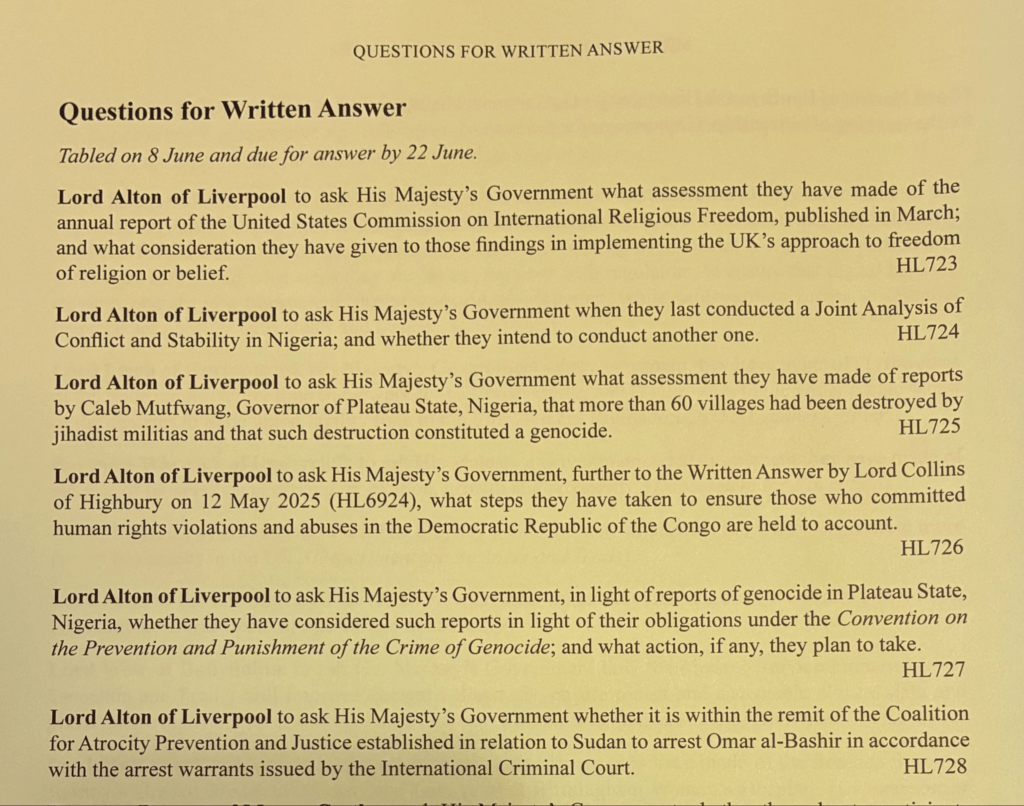
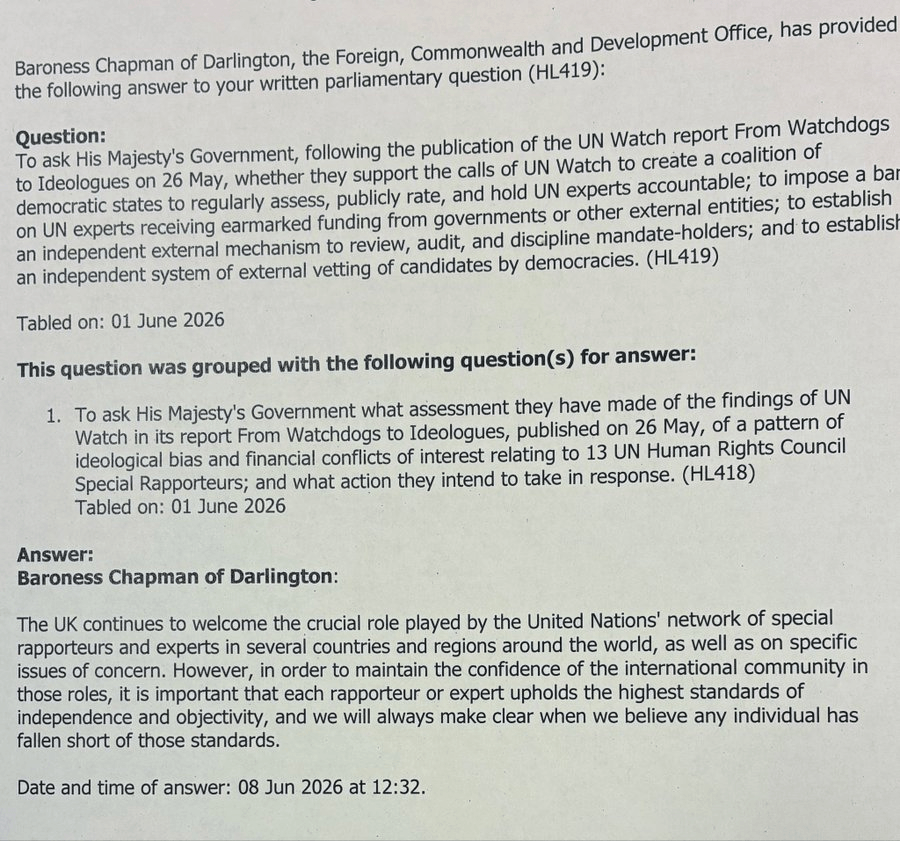
Some New Questions Tabled – Atrocity Crimes in Sudan, Nigeria, DRC and the Independence of UN Special Rapporteurs.