Genocide Watch Report Genocidal RSF reach 500,000 people in El Obeid, Sudan
Rebecca Tinsley: Sudan: a genocide unfolds | ICN
Telegraph:
House of Lords Statement on the G7 Summit:
My Lords, the world’s worst humanitarian catastrophe is in Sudan. Can the noble Baroness say what more was said at the G7 summit about the atrocities in Sudan, given that it is a major root cause of displaced people, of whom there are now 120 million in the world? Will she look at the statements issued yesterday by the African Union and by the US State Department about the dangers now emerging in North Kordofan, and the danger that the genocidal attack that was made in El Fasher in Darfur quite recently will be replicated? Given our duties under the genocide convention to look for emerging signs of genocide, will she take this away as a matter of great urgency?
Baroness Smith of Basildon (Lab)
Of course. I think the noble Lord has raised these issues already with my noble friend Lady Chapman, who is well aware of them, and I will pass his comments on to her. Yes, it is a matter of urgency. It is something of a shock, when we think of what is going on in the world, that Sudan gets so few column inches and so little attention in our newspapers in this country. It seems sometimes that they move on to another issue and then another, but it is still happening and is still important. I will discuss this with my noble friend Lady Chapman and see what more we can say to the noble Lord.
House of Lords Private Notice Question
Private Notice Questionhttps://hansard.parliament.uk/lords/2026-06-24/debates/DD896C67-14BA-4C9F-858E-2A9F21298F46/DarfurAtrocities
3.49pm
Asked by
Lord Alton of Liverpool
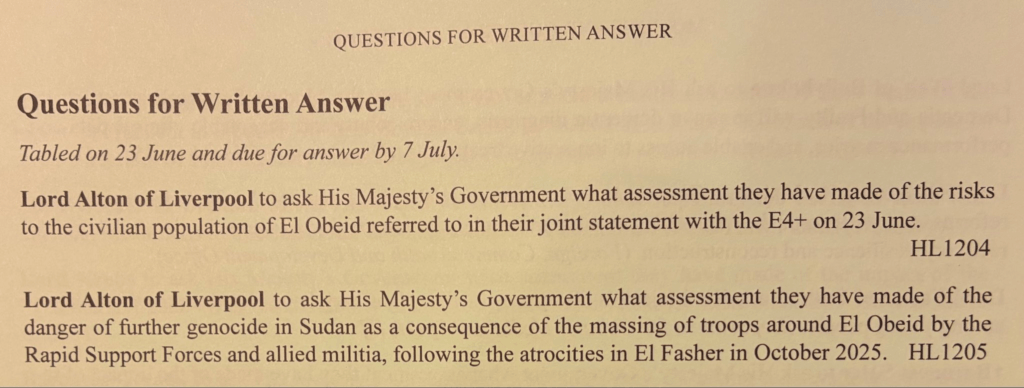
To ask His Majesty’s Government, following atrocities in El Fasher in the Darfur region of Sudan, what assessment they have made of (1) the situation in El Obeid, and (2) of the likelihood of further genocide in Sudan.
The Minister of State, Foreign, Commonwealth and Development Office
(Baroness Chapman of Darlington) (Lab)
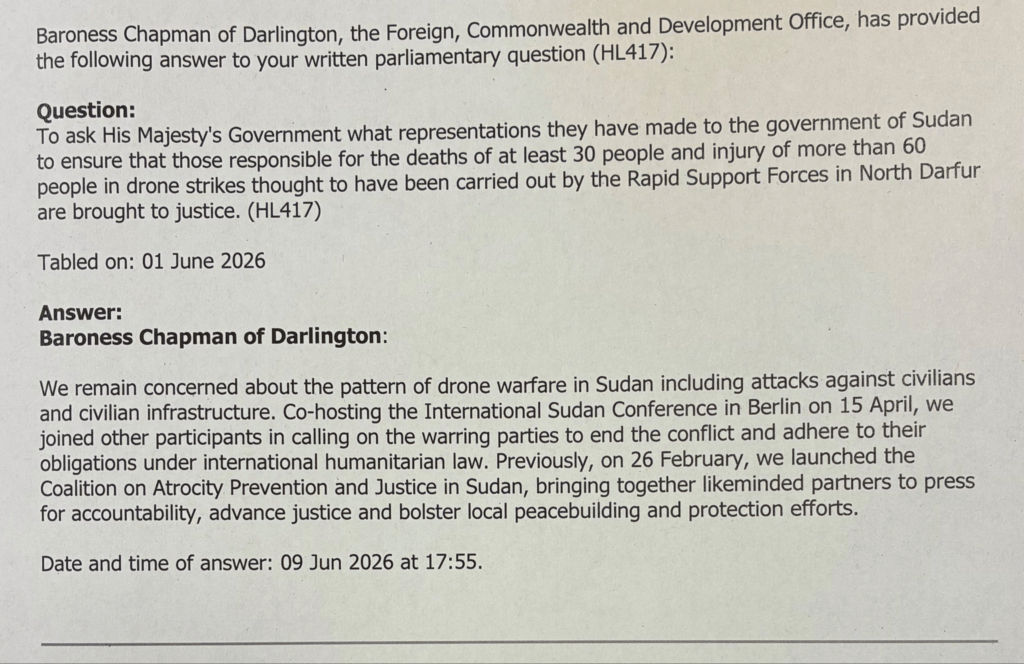
The Government are deeply concerned by reports of a potential RSF offensive on El Obeid. Last year, unimaginable horrors unfolded in El Fasher. The RSF has moved troops towards El Obeid and sent dozens of drone strikes. The risk of grave atrocities is acute. The UK maintains that genocide should be determined by a competent court. This does not prevent us taking action. The Foreign Secretary has sounded the alarm on El Obeid, mobilising the international community through the UN Security Council and the Human Rights Council and raising it directly with counterparts.
Lord Alton of Liverpool
(CB)
My Lords, I thank the Minister for that reply. The Foreign Secretary has said:
“El Obeid is on the precipice of an atrocity”,
in a country with an estimated 150,000 fatalities and between 14 million and 15 million displaced people. Given that the Foreign and Commonwealth Office said yesterday, without a court determination, that what has been happening bears all “the hallmarks of genocide”, how does the Minister counter the criticism of the Government and their policies made yesterday at the International Development Committee of another place? In order to prevent further atrocities, as penholder at the United Nations Security Council, will we now demand an emergency debate, work for the extension of the arms embargo across Sudan and consider the deployment of blue helmets and the imposition of a no-fly zone?
Baroness Chapman of Darlington
(Lab)
I was at the International Development Committee yesterday, and I thought the evidence provided by the witnesses was compelling and impressive. I did not agree with it all, but I thought that those giving evidence did themselves a great deal of credit. I have asked officials this morning for renewed advice on duty to prevent and whether our responsibilities under the genocide convention are engaged in this instance, given what has happened so recently in El Fasher. The noble Lord will know that, up to now, the UN Secretary-General has deemed that the deployment of a force to protect civilians or a Toggle showing location ofColumn 663peacekeeping force would not be possible in this situation for reasons of there being no peace to keep and the difficulties of doing that, but we will continue to look at all available avenues in this situation. We do not want to see, as we did in El Fasher, another siege situation and all that unfolded at the end of that.
The Earl of Courtown
(Con)
My Lords, I thank the noble Lord, Lord Alton, for bringing this subject to the attention of the House once again. It is an incredibly important subject, and we should be concentrating more on it. The UN Human Rights Office has said that it has verified 546 instances of conflict-related sexual violence and that sexual violence is increasingly being used as a weapon of war in Sudan. Given the UK’s experience supporting the investigation—and hopefully, later, prosecution—of war crimes in Ukraine, what plans do His Majesty’s Government have to provide equivalent support for the prosecution of war criminals in Sudan?
Baroness Chapman of Darlington
(Lab)
We have done a couple of things: we have deployed specialist teams on gender-based violence in the area, and we have a fact-finding mission. We are doing that so that proceedings can follow. I will not go into the detail of some of the violence here, but the degradation is abominable and truly shocking, and the impunity with which it is carried out is really quite shocking. We need to continue to do everything we can to prevent it and to hold those responsible to account.
Lord Oates
(LD)
My Lords, I note the Minister’s reference to the action by the Security Council and the joint statement by Foreign Ministers of like-minded countries calling for a halt on the attack on El Obeid. But does she agree that the absence of any reference to consequences in those statements renders them ineffective and, furthermore, that repeated statements over the past few years that have not been backed up by action have emboldened rather than deterred the perpetrators of atrocities on all sides of the conflict?
Baroness Chapman of Darlington
(Lab)
I have been on the record in this House on many occasions expressing frustration with the futility, sometimes, of the statements we make. They are hard to get agreed and very carefully worded, as the noble Lord knows. Do they have the real-world impact that we would wish to see? The truth is, not often enough. That does not mean it is wrong to pursue them, because the more light that is shone on these atrocities, the better. It is really important that we do that. I think we all agree that not enough attention is paid to this conflict and to what is happening in Sudan. They are an important tool. Are they sufficient? I agree with the noble Lord that they are not.
Lord Davies of Brixton
(Lab)
I thank the noble Lord, Lord Alton, for his important Question. I know that my noble friend the Minister is well aware of the nature of the appalling tragedy taking place in Sudan. One of the factors fuelling the extent of that ongoing tragedy is the continued supply of modern weaponry, Toggle showing location ofColumn 664drones and the training of mercenaries. Does she agree with me that our Labour Government should do all that they can to prevent the supply of such equipment? It is fuelling this disaster.
Baroness Chapman of Darlington
(Lab)
Absolutely. There is no doubt that this conflict is being prolonged and intensified because of the supply of drones and other high-tech equipment to armed groups within Sudan, not just the SAF and the RSF but many others. There are now double digits of countries involving themselves in this conflict. They need to stop. That is the only way we will see any kind of resolution. We need to get on to a ceasefire, some dialogue and a civilian-led process. That is the only way forward here. The arms pumped into Sudan and the illicit gold flows need to stop, because until they do there will be no motivation for the warring parties to get around the table and resolve this.
Baroness D’Souza
(CB)
My Lords, the Government were well aware of the arms pipeline between the UAE and the RSF, which took place from mid-2023 onwards and resulted in several genocidal attacks. Therefore, there was a choice for the Government to put pressure on the UAE to stop that arms traffic, but they did not do so. Can the Minister say why that decision was made? Was it made by officials or, indeed, by the Minister?
Baroness Chapman of Darlington
(Lab)
I would like to stop arms flows from every country into Sudan. I think there should be a complete embargo, which is what the UK Government are pushing for. As for specific conversations with particular countries, I do not think there is a conversation that I or my right honourable friend the Foreign Secretary has had with the UAE or several other countries where we do not make that specific point.
Lord Ahmad of Wimbledon
(Con)
My Lords, I draw attention to my entries in the register on organisations working in the Middle East and on conflict resolution. I thank the Minister. At a time when there is a lot of challenge in the air and on budgets, I know that she prioritises the issue of conflict-related sexual violence, having visited Sudan and Darfur. She has talked of the abhorrent nature of it. Meeting the victims of sexual violence in conflict leaves an impact embedded on one’s brain and heart. Therefore, I commend what she has done to continue what I hope she recognises as the important work of the previous Government.
My focus is very much on conflict resolution. What specific role is the United Kingdom playing in support of the efforts of the Quad, which brings all the key parties together, and notably the United States, to bring an end to this awful conflict?
Baroness Chapman of Darlington
(Lab)
We very much support the Quad process and have been active in doing so. We have provided channels of communication in support of the Quad. It is not the only process and there are other tasks to be undertaken. The UK is also involved in the civilian track because when, God willing, Toggle showing location ofColumn 665a ceasefire is achieved, we need to have that track up and running and in play. We are actively involved, alongside other partners, in having the relevant conversations to bring that about.
Baroness Blower
(Lab)
My Lords, I thank my noble friend for all the answers she has given, as I thank the noble Lord for asking the Question. Only this week it was said in this Chamber that the conflict in Sudan does not have a high enough profile in our own media here and everywhere else. Will she talk to her friends and colleagues about whether it is possible to open a safe and legal route for any of the population of Sudan who would wish to come to the UK to escape the terrible situation they are in? We know that we have a large diaspora in the UK. It may be that, through a safe and legal route, we could alleviate the suffering of small numbers of people.
Baroness Chapman of Darlington
(Lab)
Obviously, that is a matter for the Home Office. I point out that most Sudanese refugees I have spoken to wish to stay in their region. They are furious about what is happening to their country. They feel very strongly that they wish to return and to provide leadership and support for the services that are needed to rebuild and reinstate peace. The UK supports millions of people on the borders of Sudan. It is desperately sad that they are unable to return home at this moment.
Lord Bellingham
(Con)
My Lords, I too support the Minister’s robust and strong response. She mentioned the illicit flows of gold. Is she aware that the RSF has been exporting substantial quantities of gold to countries such as Kenya, Ethiopia and the UAE to help finance the provision of weapons and arms? Twenty years ago, there was a lot of focus on blood diamonds in west Africa. This blood gold is fuelling this truly horrendous conflict. Can more be done to try to expose the people who are buying this gold and to find ways of tracking and tracing it?
Baroness Chapman of Darlington
(Lab)
Yes, that is a very good suggestion. It is why we had an illicit gold conference recently. I am well aware of the problem the noble Lord describes. The idea of having a consumer-facing campaign around this is excellent. I would like to get involved in leading it. It is so destructive, and it is without doubt fuelling this conflict. I would welcome any move to make consumers more aware of where their gold comes from and of the fact that it can be used to support the devasting atrocities that we see in Sudan.
Baroness Hussein-Ece
(LD)
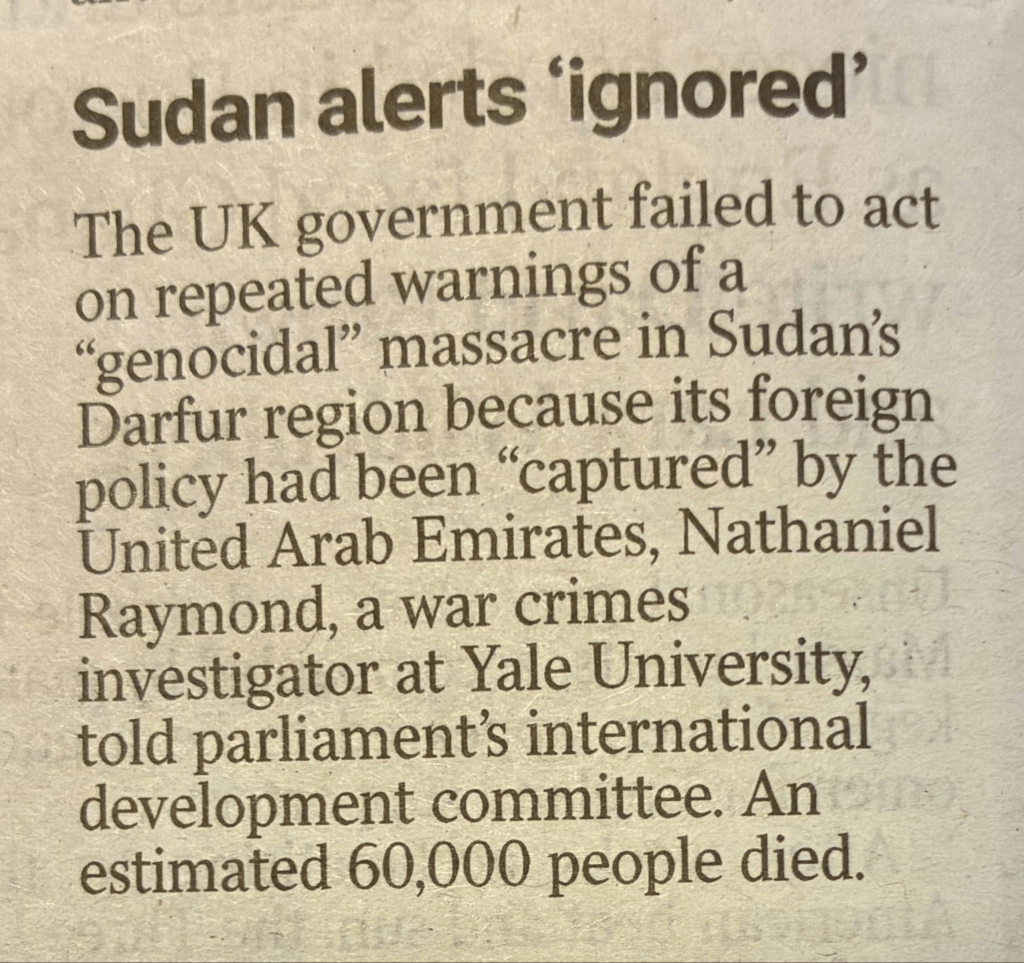
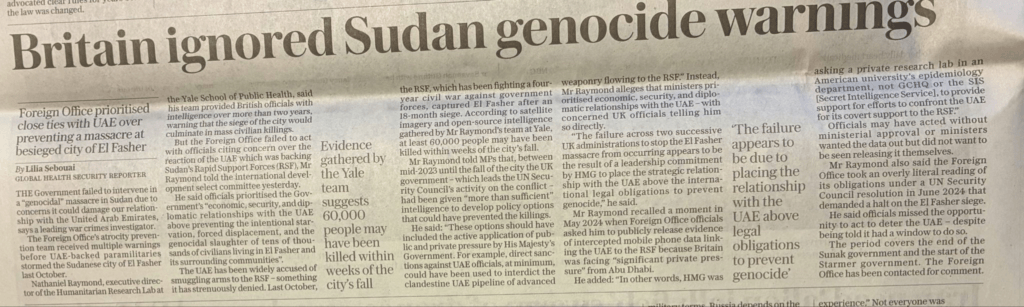
My Lords, I take the Minister back to the International Development Committee meeting that she attended yesterday, which has already been referred to. Nathaniel Raymond, executive director of the Humanitarian Research Lab at the Yale School of Public Health, testified that the UK had failed to act on intelligence and genocide warnings in Sudan. He specifically said that there had been not enough political will, and that it was blocked by the UK’s unwillingness to confront the UAE, the primary military enabler, as we know, of the RSF massacre Toggle showing location ofColumn 666in El Fasher in 2025. What direct representations were made in response to the intelligence that was received in order to try to combat an impending genocide?
Baroness Chapman of Darlington
(Lab)
I have huge respect for Nathaniel, but I disagree with the analysis that some options were put to Ministers and we chose the least. That is just not my version of what happened. It is important that analysts are able to give their perspective, but sometimes it is also acceptable for government to gently push back and disagree. There are things we can do to attempt to prevent these kinds of atrocities, but we have to be completely honest about the extent of our powers in some of these situations. I think that because El Fasher happened we are seeing a very different approach to El Obeid, and we are being much more active. That is because of the visibility of the atrocities. We saw people videoing themselves committing those heinous acts in El Fasher. I respectfully disagree with Nathaniel on the narrow point that he made yesterday, although I have enormous respect for him.
Baroness Bennett of Manor Castle
(GP)
My Lords, it was recently reported that hundreds of Colombian private military contractors, apparently hired by a UAE-based company, transited through UAE military facilities before being deployed to Sudan to support the RSF. Are the Government aware of this case, and have they made representations to the UAE about it?
Baroness Chapman of Darlington
(Lab)
We make frequent representations and I am aware of the Colombian link, alongside the links of very many other nations. This needs to stop. As long as this continues, this conflict will persist. We will not see the loss of life, the degradation of communities and the hideous sexual violence finish until other countries desist and stop fuelling this conflict.