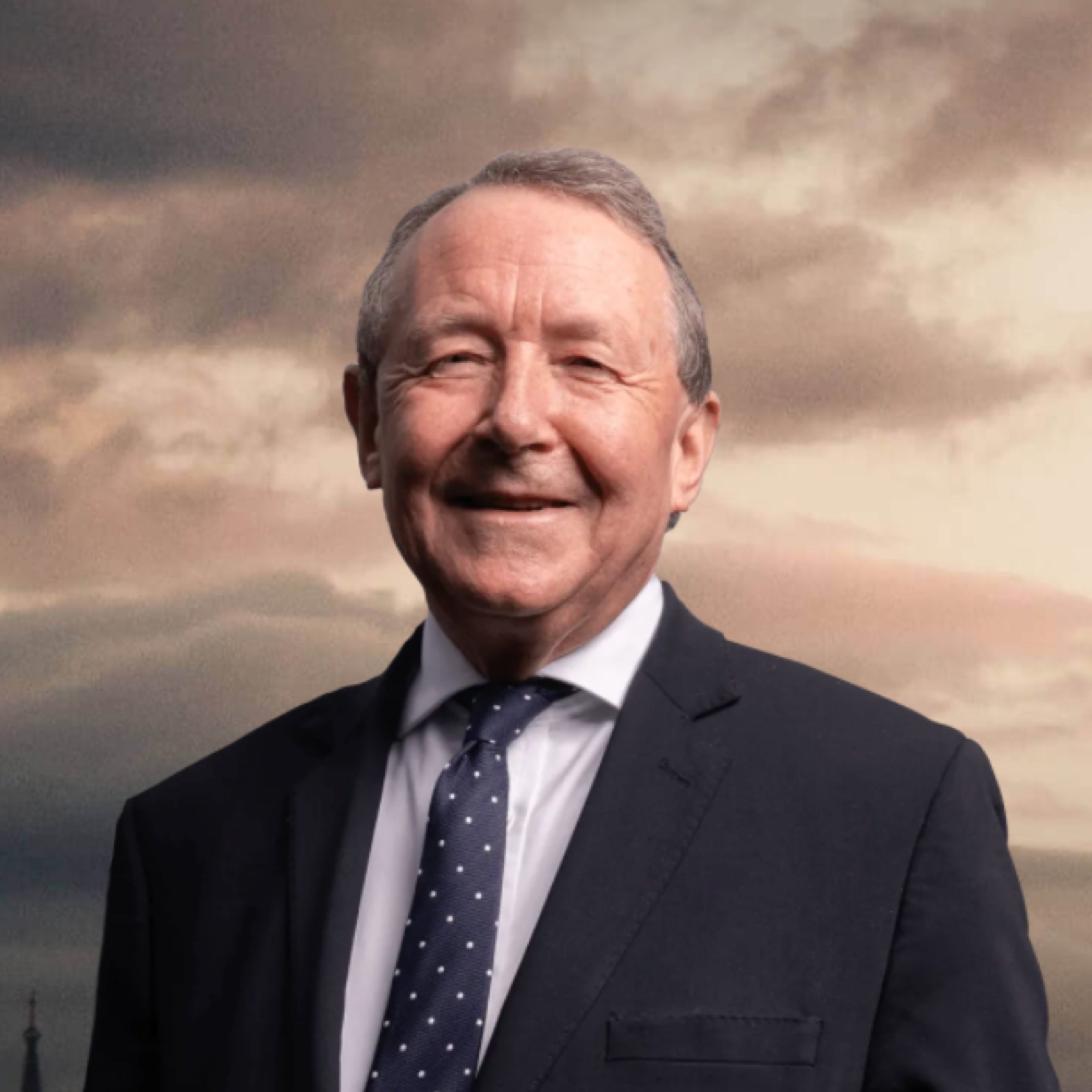
Barbara in 1990 having taken charge of my constituency office.
I am profoundly grateful to Claire and Mark – through the ever-faithful Malcolm Kelly – that I was alerted to the serious deterioration in Barbara’s health.
It enabled me to get to Liverpool Royal Hospital in time for Lizzie and I to see Barbara and to say what would be our farewells.
She was facing the journey which lies before us all with characteristic calm and peace – still concerned more about others than she was about herself.
When the end did come, she was with members of her dearly loved family to whom she was always devoted and of whom she was inordinately and enormously proud.
No conversation with Barbara was ever complete until I had heard how her children and grandchildren were getting on – and, even now, I can imagine Barbara looking out for them from her celestial vantage point.
As today we mark the life of this kind and good woman, she would want us to celebrate and share that love she had for Claire and Mark and especially for her grandchildren, Millie, Pascal, George and Oscar, and who now have the responsibility to carry Barbara’s brightly lit torch into the next generation.
Along with John, Laura, and Dom, and all who knew Barbara through her civic, political, university, and charitable work, we have all come to Holy Trinity today – a church which was special for Barabara – to mark that special life.
Barbara’s was a life rich in its service and its love of others. It chimed with John F. Kennedy’s famous call to civic engagement. He said in his Inaugural Address: “Ask not what your country can do for you, ask what you can do for your country”.
Barbara believed citizens should focus on their responsibilities and contributions to their nation rather than solely on what the nation can provide for them. It is a call to action for individuals to actively participate in their communities and work towards the betterment of society. And she put those words into action.
I first met Barbara in 1988 after she applied to run my constituency office and in one capacity or another Barbara collaborated with me for three decades.
That year, the BBC had discovered, through the Members’ Post Office at the House of Commons, that in the previous twelve months I had received more letters and correspondence than any other Member of the House of Commons. Barbara knew what she was taking on.
She was completely unphased by the volume, by the controversies, by the phenomenal workload, or by the individual cases generated by long long queues at weekly surgeries and a diverse but wonderful constituency which stretched from the Adelphi Hotel to the Garston by-pass.
One of her very first assignments was to join me at a large, over three hundred strong, public meeting which had been called to oppose a proposal from the City Council to build a dual carriageway across Otterspool Park.
The meeting was chaired by a young 18-year-old called Malcolm Kelly.
Impressed by someone so young taking on the Council, its officers, and councillors, it forged a friendship and working relationship which would span 37 years and deepen after Malcolm joined Barbara as a City Councillor in Woolton Ward won in 1995 by the narrowest of margins.
Barbara proved herself to be a diligent and conscientious City Councillor.
For ten years she served as the Assistant Executive Member for Regeneration. Much of the city’s regeneration is a testament to her hard work during that period.
She took the idea of active citizenship really seriously- getting involved in many voluntary organisations – doing what she could for her community, as Kennedy put it.
She particularly delighted in her work as a Trustee of the charity, Epiphany Trust and her work with Woolton in Bloom, where she was one of the initial team of volunteers that set it up in 2001, acting as Chair for many years.
Its amazing success was recognised through North West in Bloom awards and Britain in Bloom awards including the Champion of Champions Gold Award.
In other Ward work she helped to set up Friends of Gateacre chairing it right up until her admission to hospital.
She was a Governor of Woolton Primary School and a Trustee of Woolton Educational and Recreational Trust, helping over the past 25 years to distribute over £350,000 to good causes in the Woolton area.
Always ready to embark on something new, Barbara also organised a visit to the European Parliament for family friends and colleagues.
It proved so successful that ‘Mace’s Tours’ as they became fondly known – led to expeditions to Granada, Barcelona, Copenhagen, Dublin, Seville, Paris, Amsterdam, Stockholm, Venice, Lisbon, and Berlin.
Earlier this year, in March, Barbara’s civic contribution was recognised and honoured through her appointment as an Alderwoman. It was well deserved.
In 1997, when I decided to stand down from the Commons, Barbara came with me to the Liverpool John Moores University where she became the office manager of the Foundation for Citizenship, which I founded, and she did much of the organisation of around 130 Roscoe Lectures.
Her humour, energy, enthusiasm, calm and professionalism marked her approach to both our Lectures and Good Citizenship Awards, which were presented to thousands of young recipients across the five Boroughs of Merseyside.
The awards bear the words “men and women for others” – words which themselves sum up Barbara’s attitude to life.
At the public lectures we would showcase one of the young recipients. Barbara would put them at their ease before bringing them to the rostrum to hear their stories celebrated before large audiences of people.
Every year around 10,000 people attended the Roscoe Lectures – the biggest regular spoken word events in the UK – and which were delivered by some amazing people – including the Prince of Wales, now King Charles, His Holiness the Dalai Lama, the Presidents of Ghana and Ireland, former Cabinet Ministers, political leaders, writers, artists, musicians, poets, academics, military leaders, religious leaders – including cardinals, archbishops, and rabbis – and survivors of holocaust and genocides and more besides.
Barbara would follow up my invitations, ensure venues had been booked, think through the logistics, meet, and greet, ensure that everything went smoothly – even managing to get Ken Dodd to finish his lecture on time on the role of humour in our lives.
Among my memories of Barbara’s unflappability was from the year 2000 when the broadcaster Melvyn Bragg – who would speak to millions over the BBC radio waves – looked panic stricken when he saw seats set out for one thousand people in St. George’s Hall. He was even more panicky on realising that he had left his glasses on the train and could not read his notes. Barbara immediately went over to Lime Street Station, stopped the train from leaving, and returned with his glasses in her hand.
The lecturer breathed a sigh of relief, and the lecture proceeded without a hitch – including what became a regular feature, some music from the Father Willis organ played by Stephen Derringer of this parish.
Nothing phased Barbara and, as many here today will testify, her fantastic work in being the go-to person for the Foundation and for the Lectures was indispensable.
Rob McLoughlin, the former political editor of Granada, who was present at the very first Roscoe Lecture, has sent me a message today expressing his condolences, describing her as fiercely loyal and always wonderful to deal with.
When in the summer of 2016 I decided to draw stumps at the University and to take on additional parliamentary responsibilities I ensured that Barbara would be able to remain in post at the Foundation.
She told me: “I’m not working for anyone else. I’m going to step down too.” Although it was the end of a chapter for neither of us was it the end of the book and we remained friends.
On hearing of her death, all of the team at LJMU, her colleagues in politics – and all who worked with her or knew her – have expressed their sadness and have said how much they will greatly miss that calm unflappability, her kindness and consideration for others, her professionalism and deep commitment to her family, her city, and to her work.
Barbara was animated by a deep, quiet, and abiding faith.
We once had a lengthy conversation about a radio programme in which I had been asked to talk about TS Eliot’s poem “Four Quartets.” I had chosen lines from the section known as East Coker. It begins with the words “In my beginning is my end,” and concludes with the words “In my end is my beginning.” In my end is my beginning.
Eliot’s poem reflects on the cyclical nature of life, death, and renewal, drawing from his personal experiences, his philosophical reflections, and his faith that death is not the end.
Barbara’s own faith was as deep as a Welsh valley and was intrinsic to her life – even in difficult times, to which she was no stranger.
But she knew – and would want us all to know – that beyond the difficult times, beyond the pain, and beyond the grief that many of us will be feeling today, especially the family she loved so dearly, she would want us to know that there is life in abundance: that as the poet wrote “in my end is my beginning.”
So, may Barbara’s memory be a blessing, her life an example, her public service instructive and her beliefs pass to her children and grandchildren, and may she now rest in peace and rise in glory.
Requiescat in pace.